Wednesday, 22 May 2019

The Day I Left my Job and Flew a Kite


Image by Free-Photos from Pixabay

It was the best of days, it was the worst of days. But mostly it was the best of days. I was twenty years old and I had just completely humiliated myself by leaving a job five days into it. And I couldn't have felt more free.

Fresh out of teacher's training college, I was young and idealistic. I wanted to teach in a school that valued learning and creativity more than uniformity and blind obedience. I applied at one school that met my high standards, but didn't get through. I wasn't sure what to do next, but at the urging of some family members who told me not to expect the perfect situation, I applied at another school. This one was Catholic and catered to children from lower-income families, so it appealed to my naïve desire to 'make a difference'. Little did I realize that just because a school worked with the poor didn't mean that the school authorities loved or served them like I assumed they would.

The school year had just begun, and one of their teachers had dropped out. I didn't know why, and didn't wonder then. The first day they put me in a first standard class with over seventy children. Yes, the strange hierarchy and systems of Indian schools put a brand-new inexperienced twenty-year-old teacher ALONE in a class of seventy six-year-olds, instead of an experienced teacher, because those teachers had paid their dues and didn't want to be stuck with the toughest class in the school.

No assistant teacher. Seventy little faces stared at me. They didn't speak English yet. They had never sat in a class for seven hours before. They were rowdy kids from tough backgrounds stuck in a situation in which it was impossible to give them individual attention. I tried to teach them, but there wasn't a moment where the entire class was listening. They were miserable, and so was I.

On the first day, some kids in my class got into a fist fight, and blood was drawn. Yes, by six year olds. I had no idea what to do. I tried to ask the other teachers for help, but they didn't know what to say. That's just the way it was. New teachers get the short end of the stick. They enlightened me about other rules.

"I saw you leaning against the table. Teachers aren't allowed to sit down in class."

"What? Why?"

"That's the rule. There are no chairs in the classrooms, because teachers aren't allowed to sit down while teaching."

"But.. But.. We don't have any off periods. That doesn't sound fair."

"That's the rule."

During the recess, I walked out of the class and saw the principal make little six-year-olds kneel in the corridor as a punishment. The school authorities seemed harsh. I went home every day and cried. I cried in the staff room. I cried while trying to talk to the other teachers. I cried more in those five days than I had cried in my life. I felt trapped, but I could see no way out.

Until my parents suggested that I didn't HAVE to work in that hell-hole. I suddenly realized I hadn't signed any papers yet. I didn't NEED the job. They were paying me peanuts anyway. I didn't need to stay in a horrible job out of a misplaced sense of duty. The day I made the decision was one of the happiest days of my life.

"Want to come? We're going to fly a kite!"

There was a strong wind, and my siblings and some friends were heading to a neighbouring open field. I left the cage and my heart went flying with the kite. I will never forget the feeling of freedom I tasted that day, as the kite danced in the breeze.

It's so embarrassing to admit I left a job within five days. In every inspiring story about a teacher who faced terrible odds, that's just the first part of the story. They usually persevere and then they have breakthroughs and then their students become brilliant achievers. Not me though.

Did I leave too soon? I'll never know. What I do know is that after working in an corporate e-learning company for two years, I returned to mainstream teaching in a village for a year. It was one of the best years of my life. I had thirteen eight-year-olds, and a school whose vision was teaching kids to love learning. I was still a brand new teacher, but I had a free hand to work with those thirteen students. I was happy, my students thrived and we all learned together. I have worked successfully with many children since then, and I am happy that my ideals and my desires were not squashed or dimmed by a harsh, oppressive teaching environment. So I guess, no, I'm not sorry I left my job and flew a kite that day thirteen years ago.


Related Reading

I Don't Miss School

Friday, 17 May 2019

Part 3 - Non-Christians in Heaven - Ten Catholic Teachings Most Indian Catholics Get Wrong

Have you done the quiz yet? Don't read this until you've done the quiz!

How Much Do You Know About Catholic Teaching?

To recap, I left some seeds of truths in the wrong answers, and the correct answers didn't always include the full truth. Really the question should have been 'Which option is the closest to the truth?'
(Continuing from Part 1 and Part 2.)


Image by Gerd Altmann from Pixabay

5. Will non-Christians make it to heaven?

CORRECT ANSWER 1. Possibly - Those who, through no fault of their own, do not know the Gospel of Christ or his Church, but seek God with a sincere heart, and, moved by grace, try in their actions to do his will as they know it through the dictates of their conscience may achieve eternal salvation.
2. Of course - God doesn't care what religion we belong to as long as we are good people. Many Hindus and Muslims are better Christians than Christians are.
3. Not possible - the Bible clearly says 'Those who do not believe will not be saved.'
4. Hell does not exist, it was a concept made up in medieval times to scare people. God is a God of love, so all people will be in heaven with Him.

This was an easy answer to guess because I made the mistake of making the correct answer far more detailed than the wrong ones. But I just couldn't bear to cut out any part of it.

Most Indian Catholics have heard again and again the lie that all religions are exactly the same, that it makes no difference if you are Christian or Muslim or Hindu or Buddhist, that Jesus, and the founders of other religions are practically the same. This probably came as a reaction to communal tension and violence that has often been incited in parts of India, and was seen as a way to maintain peace and harmony.

But it's good to go a little deeper, both into common sense and the actual teachings of the Church.

1. All religions are NOT the same, nor are our teachings identical (although there are many common moral teachings in them). The Catholic Church DOES say there are seeds of truth in different religions. But most importantly, Jesus is not the same as Ganesh or Prophet Muhammad or Buddha, and He never claimed to be.

2. Jesus made very specific claims and gave specific instructions to His followers. If he didn't care what religions we followed, or what we believed, He would never have told His followers, "Go and teach them everything I taught you and baptize them in the name of the Father and the Son and the Holy Spirit." His followers by the way were Jews, and they became Christians too.

3. Jesus claimed to be the way to the Father, and the only One with the power to save. He founded the Church and sent His apostles to continue His saving mission. The Father has revealed Himself to the people who have been trying to find Him - through His Son Jesus.


4. If you have experienced Jesus' salvation in a real way, in a freedom from sins that used to control you, in having Someone to run to when you're struggling, then you know it is NOT the same thing to know Jesus as not to know Him.

It is impossible to persevere in a fervent evangelization unless we are convinced from personal experience that it is not the same thing to have known Jesus as not to have known him, not the same thing to walk with him as to walk blindly, not the same thing to hear his word as not to know it, and not the same thing to contemplate him, to worship him, to find our peace in him, as not to. Joy of the Gospel 266

5. But we do NOT believe that means all who are not Christians are consigned to hell. That sounds very unjust and God is not only just, but also merciful. So how does this work together?

6. Here's a little more from that section of the Catechism of the Catholic Church.

"Outside the Church there is no salvation" How are we to understand this affirmation, often repeated by the Church Fathers?Re-formulated positively, it means that all salvation comes from Christ the Head through the Church which is his Body: This affirmation is not aimed at those who, through no fault of their own, do not know Christ and his Church: Those who, through no fault of their own, do not know the Gospel of Christ or his Church, but who nevertheless seek God with a sincere heart, and, moved by grace, try in their actions to do his will as they know it through the dictates of their conscience - those too may achieve eternal salvation. CCC 845 - 847

7. This means it is POSSIBLE for them to be saved if they do not know the Gospel of Christ or his Church, have never been introduced to Him in a way they could understand, but sincerely desire to know and do His will. C.S. Lewis (who isn't Catholic) used a great analogy in The Last Battle and later said, "I think that every prayer which is sincerely made even to a false god, or to a very imperfectly conceived true God, is accepted by the true God and that Christ saves many who do not think they know him. For He is (dimly) present in the good side of the inferior teachers they follow. In the parable of the Sheep and Goats those who are saved do not seem to know that they have served Christ."

8. That doesn't mean we shouldn't consider the task of evangelization urgent. Just like us, people of all faith backgrounds are susceptible to sin, deceived by the Enemy in a myriad of ways, hungry and thirsty for the One who is truth and love, who brings the fullness of life, but chasing after the things that fail to satisfy. They need Jesus too. They MAY not make it to heaven (and we may not too if we do not daily accept and walk in the salvation Christ won for us).

9. The question we need to focus on is not who will or will not be saved, because we have not been given that information. Instead reflect on this - 'Those who are incorporated in the Catholic Church ought to sense their privilege and for that very reason their greater obligation of bearing witness to the faith and to the Christian life as a service to their brothers and sisters and as a fitting response to God. They should be ever mindful that "they owe their distinguished status not to their own merits but to Christ's special grace; and if they fail to respond to this grace in thought, word and deed, not only will they not be saved, they will be judged more severely."' Pope John Paul II, Mission of the Redeemer 11

This was a pretty detailed explanation, but it deserves and needs more than a short or incomplete answer.

I highly recommend watching Bishop Barron's video on the same topic.


Related Reading

Should Conversions Be Illegal?

Monday, 13 May 2019

Part 2 - Fasting - Ten Catholic Teachings Most Indian Catholics Get Wrong

Have you done the quiz yet? Don't read this until you've done the quiz!

How Much Do You Know About Catholic Teaching?

To recap, I left some seeds of truths in the wrong answers, and the correct answers didn't always include the full truth. Really the question should have been 'Which option is the closest to the truth?'

(Continuing from Part 1)


3. Are Catholics required to fast from meat on Fridays? 

1. No; that rule was revoked with Vatican II
2. Yes; any practising Catholic abstains from meat on Fridays as every Friday is a special day of penitential observance
3. No; except for Fridays in Lent
CORRECT ANSWER 4. Yes; unless they replace it with another form of penance

Can. 1250 The penitential days and times in the universal Church are every Friday of the whole year and the season of Lent.

Can. 1251 Abstinence from meat, or from some other food as determined by the Episcopal Conference, is to be observed on all Fridays, unless a solemnity should fall on a Friday. Abstinence and fasting are to be observed on Ash Wednesday and Good Friday.

Can. 1253 The conference of bishops can determine more precisely the observance of fast and abstinence as well as substitute other forms of penance, especially works of charity and exercises of piety, in whole or in part, for abstinence and fast.

So nope, Vatican 2 did not revoke the call to penitential acts on every Friday. Oops on behalf of myself and many other Catholics who assumed that. It doesn't have to be meat, but it does have to be something that the bishop's conference of your country prescribes.

So what does the Conference of Catholic Bishops of India aka the Episcopal Conference for the Latin Rite in India say about our Friday penitential practice? From a document called Complementary Legislations to the Code of Canon Law, I learned something new-

This Conference decrees that our faithful fulfill the obligation of abstinence, besides the traditional one of abstinence from meat, by choosing at least one of the following forms of prayer/penance/works of charity: 

1. attending Mass or making a 15 minute visit to be Blessed Sacrament or doing 15 minutes of reading of the Bible or a 15 minute meditation on the Passion of Our Lord or making the Way of the Cross; 
2. missing breakfast or any one meal; 
3. taking strictly vegetarian meals (avoiding fish and eggs as well); 
4. abstaining from alcohol (for those who drink); 
5. abstaining from smoking (for those who smoke); 
6. abstaining from beverages (like tea/coffee between meals); 
7. giving 10% of one's daily earnings in charity
8. abstaining from meat for those for whom meat is part of their regular diet.

Nothing very demanding, but a small way to unite ourselves with Jesus' sacrifice on the Cross.

4. Do we need to fast before Mass? 

1. Yes - For one hour before Mass starts
2. No - God doesn't care
3. Yes - Except for liquids like coffee
CORRECT ANSWER 4. Yes - For one hour before receiving Communion

I was once selling Christmas cake outside Church, and we were offering free samples. A lady was rushing in for Mass, but stopped when she saw the free samples. As she lifted the cake to her mouth, I being an incurable teacher of the faith, asked, "Aren't you going for Mass? What about your Eucharistic fast?" She laughed as she popped the cake in her mouth, "God doesn't care about that." A lot of people either seem to not know or not care. Are we being too focused on unimportant rules?

Like I wrote in my post Nitpicky Church Rules a few years ago, 'The disciplines He asks of us are out of love. When I fast for an hour before Communion, I am more conscious of what is about to happen, Who I am about to meet. I am consciously emptying myself physically and spiritually, instead of casually walking in, unaware of the Guest awaiting me.'

What does the Church say?

Can. 919 §1. A person who is to receive the Most Holy Eucharist is to abstain for at least one hour before holy communion from any food and drink, except for only water and medicine.

Now you know.

Stay tuned for Part 3. 

Thursday, 2 May 2019

Part 1 - Parents and Children - Ten Catholic Teachings Most Indian Catholics Get Wrong


Have you done the quiz yet? Don't read this until you've done the quiz!

How Much Do You Know About Catholic Teaching? (Click the link to do the quiz.)

A lot of you may be mad at me for this, but I was kind of tricky in my quiz, leaving some seeds of truths in the wrong answers, which obviously made it harder to get the correct one. Also the correct answers didn't always include the full truth. Really the question should have been 'Which option is the closest to the truth?' But if you read carefully and have a very good understanding of the nuances of Catholic teaching, you would have got a good score that you can be proud of.

And if you didn't, hopefully your curiosity was sparked, and you want to know how you could have possibly got that obviously correct answer wrong. So here goes! Enjoy!

1. What role does a parent play in the choice of one's career and spouse? 

1. A major role - It is the right and responsibility of the Catholic parent to direct and influence a child's choice of career and spouse according to what is best for them

CORRECT ANSWER: 2. A minor role - Catholic parents should be careful not to exert pressure on their children either in the choice of a profession or in that of a spouse.

3. A deciding role - Catholic parents should make the final decision about their child's career and spouse after listening to their child and taking it to prayer

4. An advisory role - Catholic parents should offer a selection of careers and options for spouses based on their child's personality and the needs of the family, and then allow them to choose one of the options

The tricky part was the words 'minor' being right and 'advisory' being wrong. Here's what the Catechism has to say about it.

CCC 2230 When they become adults, children have the right and duty to choose their profession and state of life. They should assume their new responsibilities within a trusting relationship with their parents, willingly asking and receiving their advice and counsel. Parents should be careful not to exert pressure on their children either in the choice of a profession or in that of a spouse. This necessary restraint does not prevent them - quite the contrary from giving their children judicious advice, particularly when they are planning to start a family.

I did use the word minor deliberately though, because it is MAJORLY the decision and choice of the individual themselves. Indian parents, God has NOT asked you to pick a spouse or a career for your child. You cannot give them a selection to choose from, or tell them they may NOT marry some particular individual, or threaten to cut them off if they do.

What you can and should do is give them judicious advice, and then pray that they make the right decision. Even better is to help and train them from the time they are young to seek the Lord, and to learn how to make wise and responsible decisions. Focus on building a trusting relationship so that they feel comfortable consulting you without feeling you will pressure them in one way or another. You cannot and should not try to control their lives.

And Catholic adults, it is your right and duty to choose your own profession and state of life and spouse. It is not somehow holier to leave it all in the hands of your parents.


2. What does a Catholic adult owe his/her parents? 

1. Nothing; an adult is responsible only for himself or herself
2. Obedience in all things and financial support as soon as and as long as they are earning as required by the commandment 'Honor your father and mother'
3. Honor and respect, unless the parents have neglected their duties as parents
CORRECT ANSWER 4. As much as they can, material and moral support in old age and in times of illness, loneliness, or distress

Another misconception in India propagated by many within the Church is that obedience to parents is the highest good, a holy and unbreakable commandment. That is not however what the Church says. What DOES it say? As CHILDREN living at home, we are expected to obey our parents in all things (except in matter of sin). But as adults, no longer under the legal custody of our parents, we do NOT have to obey them in all things. We are responsible for our own decisions, and though we should willingly seek their advice, we are not under any obligation to do what they demand or expect.

CCC 2217 As long as a child lives at home with his parents, the child should obey his parents in all that they ask of him when it is for his good or that of the family. But if a child is convinced in conscience that it would be morally wrong to obey a particular order, he must not do so.

 As they grow up, children should continue to respect their parents. They should anticipate their wishes, willingly seek their advice, and accept their just admonitions. Obedience toward parents ceases with the emancipation of the children; not so respect, which is always owed to them.

It is a little trickier when adults live with their parents as is often the case in India. My understanding though is that if you are contributing financially to the household and no longer dependent on your parents, you have the same right to make your own decisions. If things become difficult - like parents demanding obedience in unreasonable matters, it may be better to move out. And on the parents'part, if you have adult children living at home and NOT taking on their share of responsibilities at home, you may need to ask them to take on those responsibilities, or move out. The only WRONG solution is to continue treating them as if they were still children, instructing, nagging, and controlling.

Whether parents deserve it or not, we are still obligated to show them respect and honour. (That doesn't mean remaining within an abusive relationship.)

[I promise I'm going to write a Boundaries post about this topic.]


What about our financial obligations to our parents? I remember a young man in his twenties telling me that his salary went straight to his parents, and they gave him an allowance out of that. That does  not sound like a healthy parent-child relationship, but unfortunately it doesn't sound very surprising in India.

What does the Church say?

CCC 2218 The fourth commandment reminds grown children of their responsibilities toward their parents. As much as they can, they must give them material and moral support in old age and in times of illness, loneliness, or distress.

If your parents have their own source of income and are not in financial need, or are able to work, you are not obligated to support them financially. What about the money they spent on your education? Parents do not HAVE to fund your higher education. You can take loans, get scholarships, and pay your own way. Your parents could even be the ones to loan you the money. If they choose to freely save up and pay for your education, or a large part of it, then they should have done so without any expectations of return. You are free to repay them if you desire. But if they are comfortably off and you need to make financial decisions for your own spouse and children, your obligation is to your new family.

When they are older however, or struggling in any way, you ARE responsible for them, whether or not they contributed financially to your education.

There is a lot of wisdom the Church offers us about the relationships, rights and responsibilities within families. Sadly, we often take unhealthy cultural norms and act as if they are God's law. We see the ill-effects all around us, in interference and control, in resentment and rebellion, in neglect and manipulation, in irresponsible and entitled behavior. God's truth reaches into these broken places and offers us ways to set things right.

There's a lot more good stuff about the parent-child relationship in the Catechism. Go ahead and read about the fourth commandment if you're interested.

Part 2 - Coming Soon

Related Reading

A Catholic Perspective on Arranged Marriages

13 Ways Parents Can Help Their Kids Choose Christ 

Moving from Pleaser to Rebel to Lover

Tuesday, 30 April 2019

Ten Catholic Trivia Questions Most Indian Catholics Will Get Wrong


I thought I'd try something new at the blog this week - a QUIZ! Who doesn't love quizzes?

Try it out and watch this space for the follow up on all the answers. Let me know in Facebook or blog comments how much you scored!

(The quiz should appear below, wait for a few seconds if you don't see it. If you still don't see it, click on this link.)

For clarity on some of the answers, read the following posts"

Part 1 - Parents and Children 

Part 2 - Fasting

Part 3 - Non-Christians in Heaven

Monday, 22 April 2019

If Jesus Really Rose from the Dead...


Easter has begun! This of course means that our forty days of fasting and discipline are finally over and we can gorge ourselves on chocolate and junk food and movies and go back to being lazy slobs! Our reward for denying ourselves is indulging ourselves!


You think I'm being sarcastic but you know in your heart I am not really kidding. That's pretty much how we approach Easter - as no-longer-Lent, as Sherry Weddell put it in a recent post on her Forming Intentional Disciples Forum.

But Easter has got to be more than that. This is the biggest feast of the Christian Church. Even bigger than than the birth of God as a baby is the final accomplishment of everything that Baby came to do.

And what did He do? He broke the bonds of death, He spoke the final word, He won the ultimate victory in the great cosmic battle between good and evil. Picture every superhero movie you ever watched, and think of the final showdown between the hero and the villain... this is SO much bigger.

But what does this mean for you and for me today, and in the days to come?

1. WE ARE NO LONGER SLAVES

For freedom Christ has set us free, therefore stand firm and do not submit again to a yoke of slavery. Gal 5:1

We were made to be free, and we are freest and happiest when we are living as we ought, with clean consciences, and days filled with prayer, love and service. Don't fall back into slavery of seeking happiness in fleeting sensory pleasures. Lent wasn't supposed to be a 'sad' time, but a time to realign our hearts to the truth, and re-order our desires so we seek God first and most.

The Resurrection means you have a choice! You don't HAVE to be a slave to sin. You don't HAVE to be anxious and sad and angry or selfish all the time. The door of the prison cell is open - step out and live as a son or daughter of God.


2. WE HAVE SUPERPOWERS

I also pray that you will understand the incredible greatness of God’s power for us who believe him. This is the same mighty power that raised Christ from the dead and seated him in the place of honor at God’s right hand in the heavenly realms. Ephesians 1:19-20

"Have you heard of Spiderman? You know he was just a normal boy named Peter Parker who had glasses and wasn't very different from everyone else. But then he became Spiderman! And  now he can shoot webs and he has amazing vision and he can climb walls. How did that happen?"

"A spider bit him!" shout my twelve year olds at Jesus Club.

"Yes! And we also on our own are just normal human beings. We are lazy and selfish and impatient and negative. But we have our own radioactive spider - the HOLY SPIRIT!" (Theologians, please don't kill me.) "On our own, we can't do much. But with the Holy Spirit we can be DIFFERENT! We can be saints! And do you know what our superpower is?"

"Um.. we can climb walls?"

"No. Our superpower is that we can LOVE!"

I will sprinkle clean water upon you to cleanse you from all your impurities, and from all your idols I will cleanse you. I will give you a new heart and place a new spirit within you, taking from your bodies your stony hearts and giving you natural hearts. I will put my spirit within you and make you live by my statutes, careful to observe my decrees. Ezekiel 36: 25-27


This, but holier

3. WE HAVE HOPE

God indeed is my savior; I am confident and unafraid. My strength and my courage is the LORD, and he has been my savior. With joy you will draw water at the fountain of salvation. Is 12:2-3

It seems like most of us live with this cloud of gloom hanging over our heads. And who can blame us? Things in the world seem horrible. Bombings that kill hundreds of innocent people, nations torn  apart by divisive hate-filled politics, brokenness everywhere, in our families, in our church, in the news, in ourselves. It seems the best thing to do is just 'accept reality' and give up hope, just try to protect ourselves from the worst of an ugly world. People are bad, things are hopeless.

But Jesus' death and resurrection means something! Death, the ugliest and most powerful foe of all, has been defeated. It no longer has power over us! Because if Jesus really rose from the dead, then the sin and suffering and death we see all around us is NOT the final word. Our God is a God of LIFE, of newness, of new beginnings and light in what seems like crushing darkness.


The truth is that LOVE prevails. Love wins. Love has the final word. The God of life has promised to bring to life anyone who comes to Him. That newness of life begins now. We celebrate it in this Easter season. There is nothing that need rob your peace. God will bring clarity to your uncertainty about the future. He will bring healing to your wounds. He will bring good out of evil. He will get you through whatever difficult situation you're going through. We may be in the middle of a battle but the war has been won.

“Do not abandon yourselves to despair. We are the Easter people and hallelujah is our song.”  
Saint John Paul II

Related Reading

Why Are We an Easter People?

When You Are in a Dark Place and Can’t Get Out

The Antidotes to Anxiety

Friday, 12 April 2019

The Girl in the Coffee Shop

She had a book open in front of her, but she hardly glanced at it. Instead, she kept staring out of the window, occasionally leaning to the right to get a better view. I looked too, but all I could see was a short stretch of a busy street. What was she looking at? There was nothing that seemed to warrant that much interest.

She was pretty, but her posture was slouched, her hair was pulled back into a bun, and she wore no visible make up or jewelry. There was a backpack at her feet, instead of a handbag, so maybe she was a college student? But perhaps not - she didn't seem to wear the little air of self-consciousness that teenagers often do. Plus college students dress up more nowadays, don't they? Her face wore an intense, but abstracted look. What was going on in her head? And why was she sitting in a noisy coffee shop alone for over an hour?

Was she a writer, caught up in her inner world of imagination and plots? The open notebook and pen lent themselves to this theory. But then, why did she keep getting distracted by the street outside?

Maybe she was waiting for someone. When she wasn't staring at the street, she kept glancing back at the door. But the classic give away of one who waits is the constant fidgeting with the phone. 'Has he left yet? Is he late? Where is he now? What time is it?' Only the phone reveals the answers to these all-important questions - and she hadn't looked at her phone even once. Wait a minute, did she even have a phone? I hadn't seen evidence of one, and I was struck suddenly by how unusual that was. Perhaps she was one of those enlightened minimalists who feel called to live an unplugged life, to go back to simpler times. But for an enlightened, living-in-the-present-moment saint, she sure seemed pretty distracted and fidgety.

If she was expecting someone to walk in the door any second, she would probably look more eager or tense. Instead, she had a little furrow in her brow - either a thinking furrow or a worried furrow, or both, but occasionally a smile would flash across her face at a passing secret thought.

What was the secret of the girl in the coffee shop and why was she fascinated by the short stretch of road outside the window? Would I ever know, or would it be one of those unsolved mysteries that would haunt me for the rest of my life?

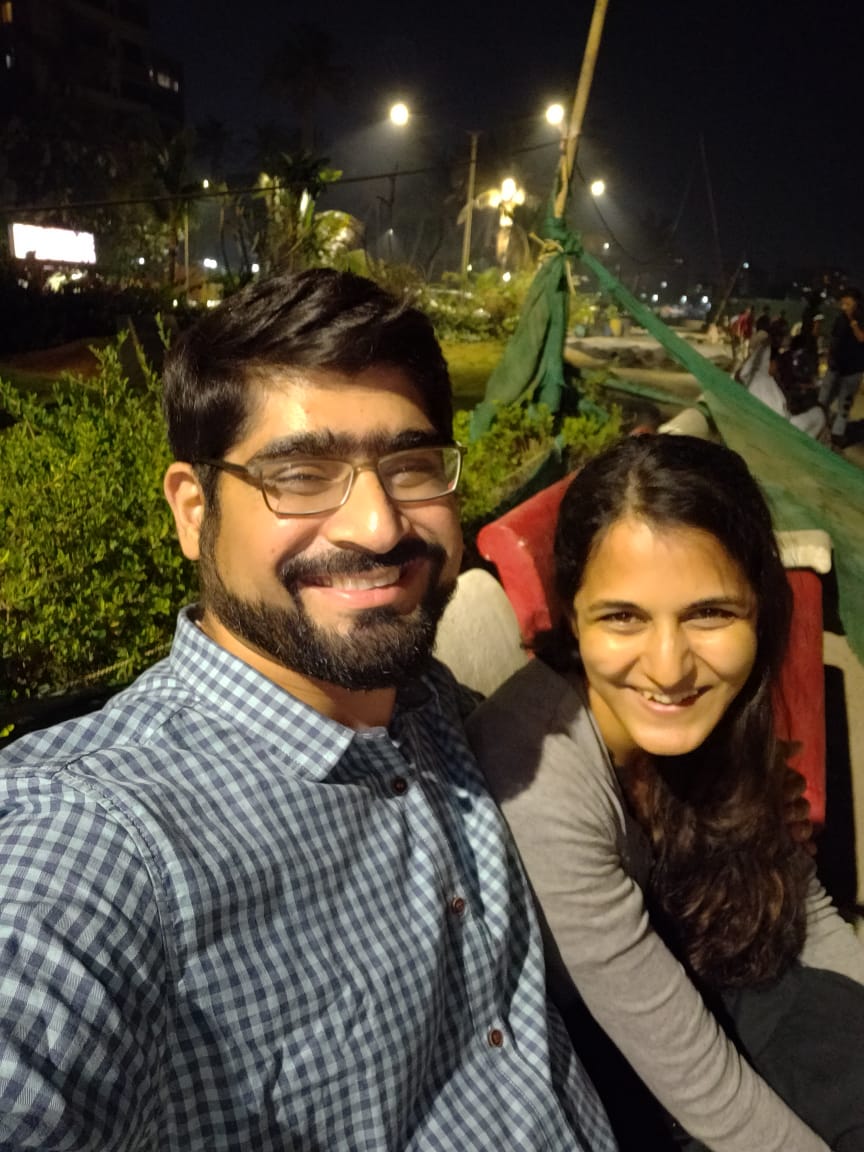
A few minutes later, she turned as the door swung open and a bearded young man in a blue checked shirt walked through. Matching smiles lit both their faces, as she jumped up, and they met in an embrace. That's when I noticed the rings on their left hands.

'Lovers', I thought, returning to my coffee. 'It's always lovers.'

A short sketch from my last visit to meet my fiancé. I had left my charger at home and my phone was dead. We had a pre-decided rendezvous point close to the hospital where he works, but he was in surgery, so for all I knew, it could have taken hours for him to finish. I wrote this sketch as I waited, from the POV of another customer.